
A few weeks back, one of my clients finally decided to move one of their WordPress websites to a dedicated VPS. What set out to be a standard procedure turned into a deep dive into the murky waters of corporate war.
For this website in particular, we used Elementor’s Kit Export feature to make the move. The website also used Advanced Custom Fields, or ACF (as it’s popularly referred to), to display metadata for a series of Podcast episodes my client produces.
During the website import, I was surprised to find an error notification informing me that ACF was “missing” from the WordPress.org plugin library. That’s odd. A discontinued plugin was not precisely ideal, to say the least. Looking for ACF manually in the WordPress plugin library only fed my fears as I effectively found ACF missing from the search results. The first result listed was a plugin named Secure Custom Fields. My confusion peaked when I looked at the top right side of the box and noticed the label “Installed.”
“A name change? What a weird move.” I thought as I pulled up a new tab and typed “ACF” in the search bar. As expected, the top result was ACF’s official website. Click.
The website loaded and I was greeted, as I’m sure many others were, with a rather unsavory announcement: WP Engine and its products were banned from WordPress.org.
I paused to digest this news before returning to Google for answers.
Search bar. “WP Engine.” Enter. News tab. Click.
Why it matters? Well…
- About 40% of all websites across the web are powered by WordPress.
- Developments hint at anti-competitive practices.
- This sets a damaging precedent for the WordPress ecosystem with collateral damage spreading to hosting providers, WordPress developers, marketing agencies, etc.
- Exposure of power dynamics in the Open Source ecosystem.
- Businesses, and people, are losing money.
- Discourages involvement and contributions from the WordPress and Open Source communities.
The claims
My search for answers led me to this 27-minute clip of Matt Mullenweg’s impromptu appearance on ThePrimeagen‘s Twitch stream.
A bit of context. Matt is the co-creator of WordPress and the current CEO of Automattic, who holds the exclusive rights to the WordPress commercial trademark license. ThePrimeagen is a developer and popular streamer with over 239K followers.

During his stream, ThePrimeagen asks Matt to help him and his audience understand the situation, which he recapitulates as follows:
“For a long time, WP was free to use as part of the terms and conditioning (sic). Sometime this year, maybe middle of the year, that was changed. Then WP Engine, shortly before WordCamp, starts receiving messages that they must pay, or else.”
Matt is noticeably bothered by the statement. He lets out a nervous giggle and his gaze starts drifting from one side of the camera to another. He squiggles in his chair regaining his composure, then smiles and attempts to make a joke to lighten the tone of the conversation.
According to Matt, the conflict is not about the “WP” abbreviation but public perception. He argues that there is a prevailing confusion among WordPress users around WP Engine’s role or involvement in the development of WordPress, which violates WordPress trademarks. Matt cites one of WP Engine’s hosting plans, “Core WordPress,” as an example.
Legitimacy of the claims
I’ll be the first to admit I thought including the “WP” abbreviation was sneaky when I first came across WP Engine’s brand. So, it wasn’t hard for me to find Matt’s argument fairly reasonable. Nevertheless, it was clear that most of his discourse in the video appeals to basic principles anyone would find hard to disagree with, like it’s bad to exploit other people’s work. Or, if you’re profiting from someone else’s work, it’s only fair to give back. It’s very easy to sympathize with similar statements but he fell short of providing any supporting evidence to the actual claims.
Therefore, in the spirit of fairness and for objectivity’s sake, I dived into the internet in a quest for clarity.
The Four Freedoms
Looking at the WordPress Foundation About page, you can find their mission is anchored in four principles or freedoms.
- The freedom to run the program for any purpose.
- The freedom to study how the program works and change it to make it do what you wish.
- The freedom to redistribute.
- The freedom to distribute copies of your modified versions to others.
These four freedoms allow individuals and companies, at least in principle, to build businesses on top of WordPress.
WP Engine has built a successful business around WordPress. However, they’re hardly the only ones doing it. Hostinger’s customer base, for example, went from 69,829 in 2023 to 368,770 in January 2025.
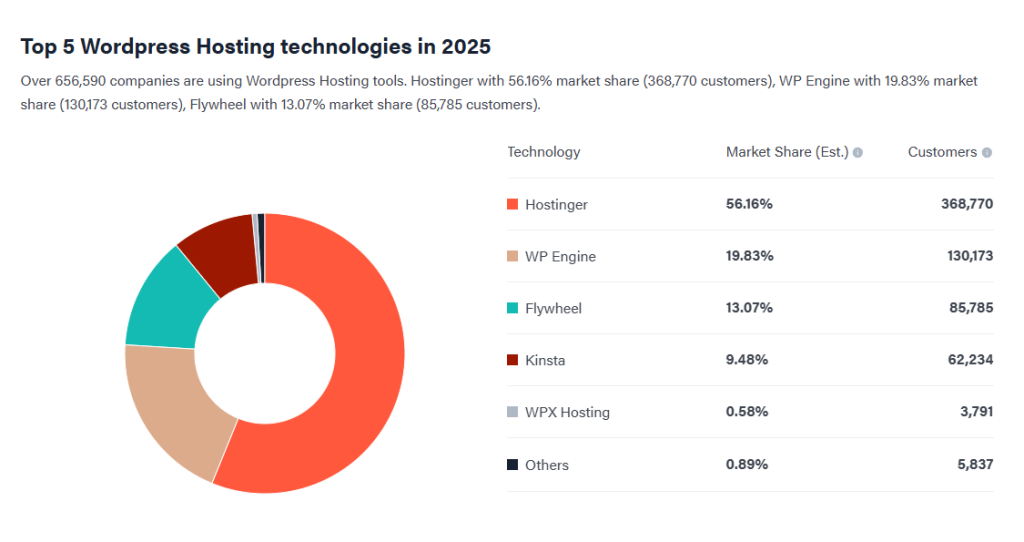
So, why is WP Engine being targeted?
The Trademark
One of the most notorious arguments raised by community members is the fact that there are a lot of companies today using the “WP” abbreviation in their brands and “WordPress” or “WooCommerce” words in their products. However, they’re not being subjected to the same PR attacks.
Furthermore, the WordPress Foundation Trademark Policy formerly, and explicitly, left the use of the “WP” abbreviation to users to do as they “see fit.” This means that including the “WP” abbreviation in a company’s name, brand, or otherwise, is not a violation of the trademark policy.
The WordPress Foundation trademark policy has since been amended. Not to restrict the use of the abbreviation but to take a jab at WP Engine.
If there is a common misconception about WP Engine’s affiliation with WordPress, Matt has failed to provide any evidence. Nevertheless, WP Engine has opted to take the higher road and make reasonable efforts to clarify any legitimate misconception about its affiliation with WordPress. In the clip, Matt acknowledges that WP Engine has renamed their hosting plans. Additionally, WP Engine updated its website in the past few months to reflect the distinction between all entities. Specifically, they included a disclaimer in their footer that reads as follows:
WP Engine is a proud member and supporter of the community of WordPress® users. The WordPress® trademarks are the intellectual property of the WordPress Foundation, and the Woo® and WooCommerce® trademarks are the intellectual property of WooCommerce, Inc. Uses of the WordPress®, Woo®, and WooCommerce® names in this website are for identification purposes only and do not imply an endorsement by WordPress Foundation or WooCommerce, Inc. WP Engine is not endorsed or owned by, or affiliated with, the WordPress Foundation or WooCommerce, Inc.
This seems like a good and reasonable point to end the conflict positively. However, the dispute has grown to cause significant financial losses to WP Engine, the businesses, and agencies depending on their products and services.
What’s left? Closing notes.
As it turns out, these developments opened a pandora’s box, exposing the power dynamics behind “democratization” and open-source software.
David Heinemmeir Hanson recently called out Automattic for “doing open source dirty.” Like him, other prominent figures have chimed in the conversation, sharing the same concerns over current leadership and governance at WordPress.
Joost de Valk makes some interesting points on the potential risks of Matt Mullenweg having the level of influence he has over the entire ecosystem.
John O’Nolan also shared an interesting perspective on governance and leadership of open-source projects and how WordPress kickstarted and shaped his own CMS project, Ghost.
Despite the apparent lack of supporting evidence or legal recourse, Matt Mullenweg and Automattic’s war efforts seem far from over. As the fog of corporate war clears, thousands of WordPress users are left to clean up the rubble. Thus, in my mind, the question that lingers is…
How open is open-source?
As we say in Mexico, “no one knows who they work for.”
* * *
Powered by WordPress